No products match your search.
How much storage do you actually need in a kitchen?
Written by Andrew Nixon
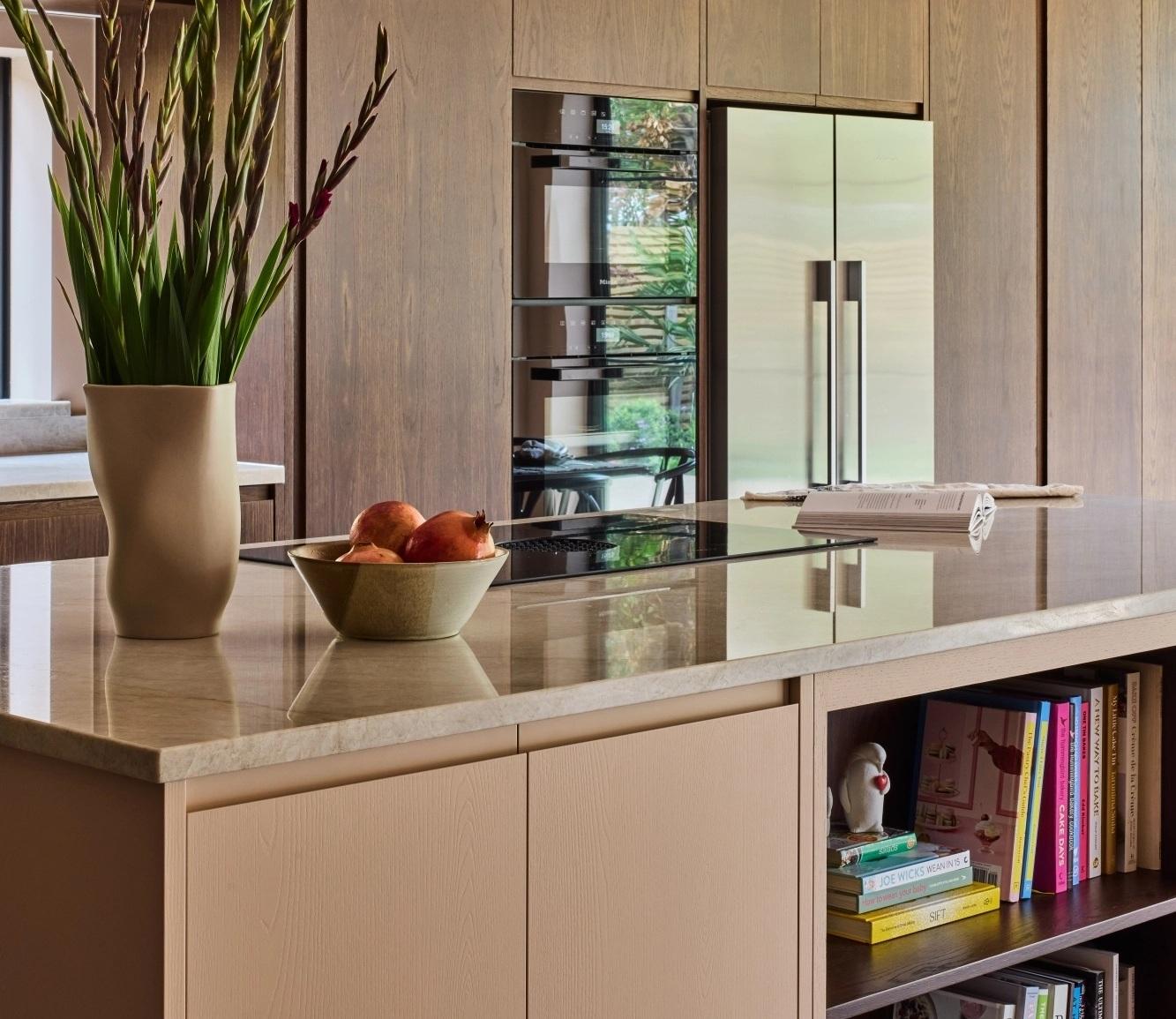
Good kitchen storage makes life easier. But how much do you really need? We look at the numbers — and why they’re only the starting point....
Why storage matters more than you might think
A beautiful kitchen can still be frustrating to use if the storage isn’t right. When storage works properly, you notice it in small, everyday ways:
- No clutter – worktops stay clearer and safer for food prep
- Ease of use – cooking feels quicker because everything is where you expect it
- Better stock management – you don’t buy duplicate jars because you couldn’t see what you already had!
- Durability – the space still works five, ten or twenty years from now
Storage determines how your kitchen functions and feels to live in – so it’s more than just a case of hiding stuff away.
How much kitchen storage do you actually need (in numbers)?
There isn’t a single official formula for kitchen storage. But experienced designers do work with broad planning guidelines to sense-check whether a layout is likely to feel generous or tight. Here are some rules of thumb…
Storage volume per person
As a starting point, many designers allow roughly 1.5–2.5 cubic metres of usable storage per personSo:
- A couple may need 3–5 cubic metres
- A family of four may need 6–10 cubic metres
This includes base cabinets, wall units, drawers and larder storage.
Of course, this varies: a passionate cook with specialist equipment will need more space for that, but these figures give you a sensible baseline.
Drawers vs cupboards: what’s the right balance?
Modern kitchen design increasingly favours drawers, which are more accessible and reduce “lost” space at the back of cupboards. (If your current kitchen involves kneeling on the floor to rummage in a dark cupboard corner, you’ll understand this!)
As a practical rule of thumb go for:
- 60–70% of base storage as drawers
- 30–40% as cupboards
In a medium-sized family kitchen, that might translate to:
- 4–6 deep pan drawers
- 2–3 medium drawers
- 1–2 cutlery and utensil drawers
- At least one tall larder or pantry cupboard
Storage per square metre
As a rough planning guide, designers often look at the relationship between floor area and cabinet run, but layout has a far greater impact than simple ratios.
As a general guideline aim for roughly one linear metre of base cabinetry per square metre of floor space. In a 20m² kitchen, that might mean 18–22 linear metres of combined base and wall storage.
Taking cabinets to the ceiling can increase overall storage by 20–30% without increasing the footprint (particularly useful in compact kitchens).
However, these aren’t rigid rules and it varies heavily depending on the layout (gallery versus L-shape versus U-shape etc).
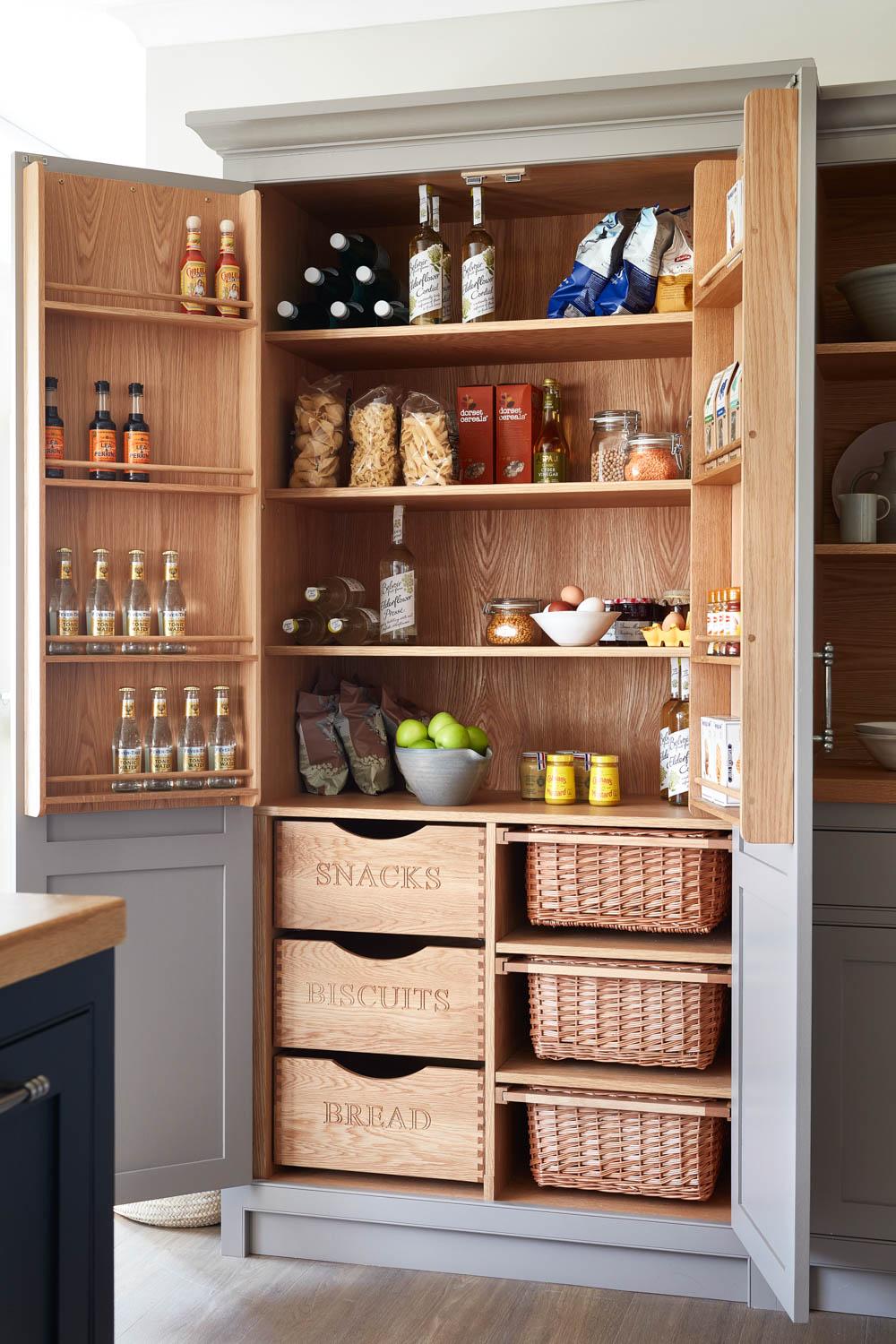
Double larder cupboard in the Raynham kitchen
What kind of storage does a kitchen need?
Whether you’re designing a new kitchen or renovating an existing kitchen, it’s important to have a range of storage that suits your needs. This will normally include a combination of wall and base units, some drawer units and a larder or food storage area. As a general rule of thumb, your kitchen storage will need to accommodate the following:
- Wall cabinets for everyday crockery and glassware
- Base units for cookware and appliances
- Drawer units for utensils, linens and smaller items
- A larder or pantry area for food storage
- Dedicated space for cleaning supplies
- Allowance for specialist items — wine storage, baking equipment, pet supplies or large gadgets
Exactly how much of each type of storage you need will depend on how you want to use your kitchen. A keen baker may need a dedicated baking cupboard; an enthusiastic host may require more glassware storage; while a bulk shopper will need a more generous pantry, and so on.
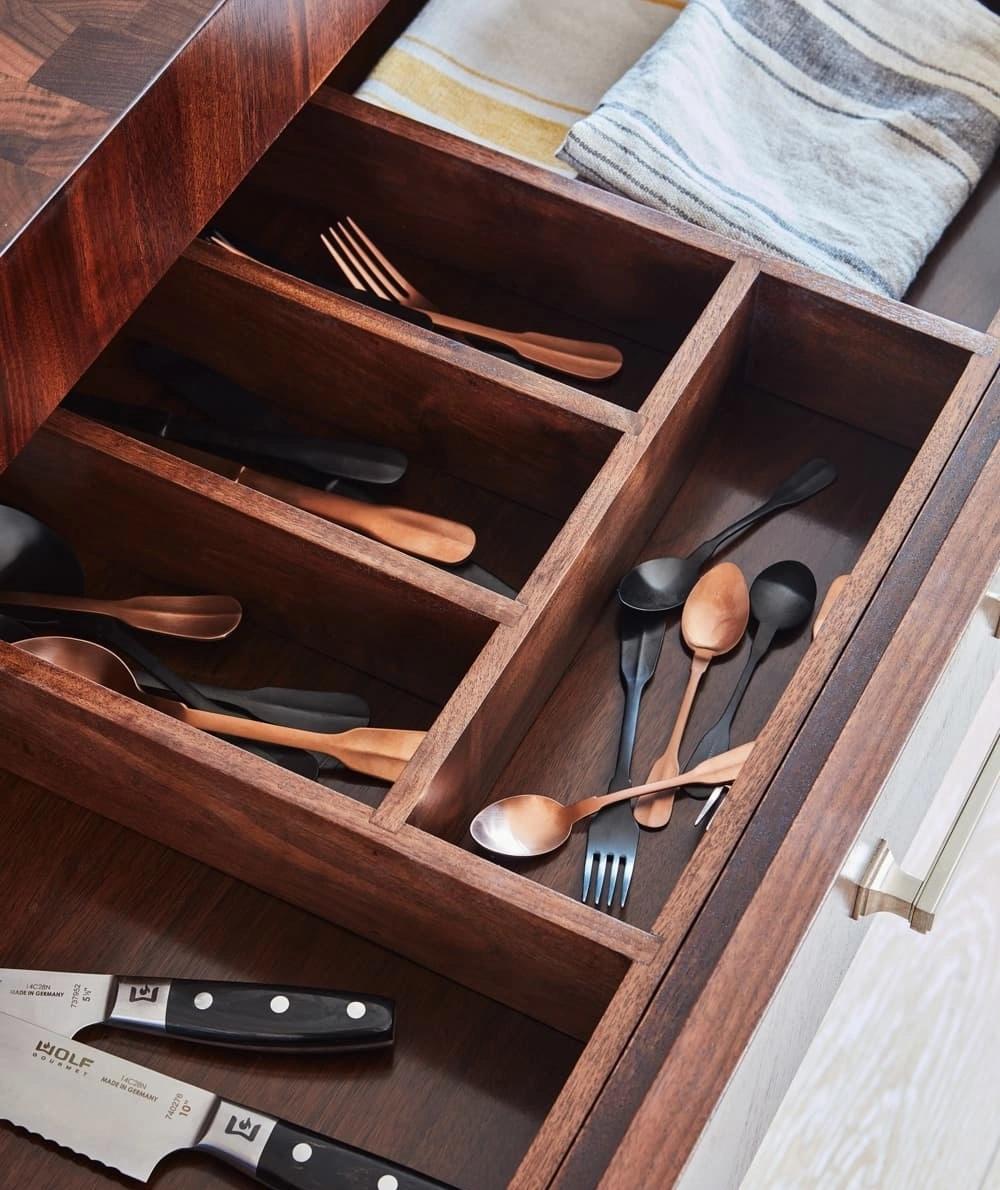
Bespoke drawer organisers keep items neatly organised <
Common kitchen storage mistakes
Even generous kitchens can feel cramped if storage isn’t designed properly.
Mistake #1: Choosing form over function
A perfectly styled island may look wonderful on Pinterest, but if it replaces essential storage, daily life becomes inconvenient. When planning kitchen storage, it’s important to think realistically about how you use your kitchen day to day, and design your kitchen storage around it, so you can create a space that’s both practical and beautiful.
Mistake #2: Overcrowded worktops
Kitchen worktops can be a handy place to store items that you use regularly for easy access. However, your counters can quickly become an unsightly dumping ground rather than a practical space for preparing food. Keeping out only what you use daily frees space for prep and creates a calmer feel.
Mistake #3: Not storing similar items together
When similar items and items often used in conjunction aren’t stored together, you waste time retracing your steps. Creating simple zones makes cooking more intuitive:
- Cooking zone near the hob
- Baking zone grouped together
- Coffee station in one defined area
Small decisions like these make kitchens feel easier to use.
Mistake #4 Wasting vertical space
Many kitchen designs fall into the trap of not making the most of the vertical space in a kitchen, leading to overstuffed cupboards and overflowing drawers. Standard kitchen wall cabinets often have a significant amount of dead space above them. By extending your kitchen wall cabinets all the way to the ceiling, you can turn the unused space into useful extra storage for less frequently used items, freeing up valuable space elsewhere.
Mistake #5: Designing for today only
Needs change as children grow up, entertaining habits evolve and kitchen equipment accumulates.
Flexible storage like adjustable shelving, adaptable larders and well-proportioned drawers helps prevent your kitchen from becoming obsolete.
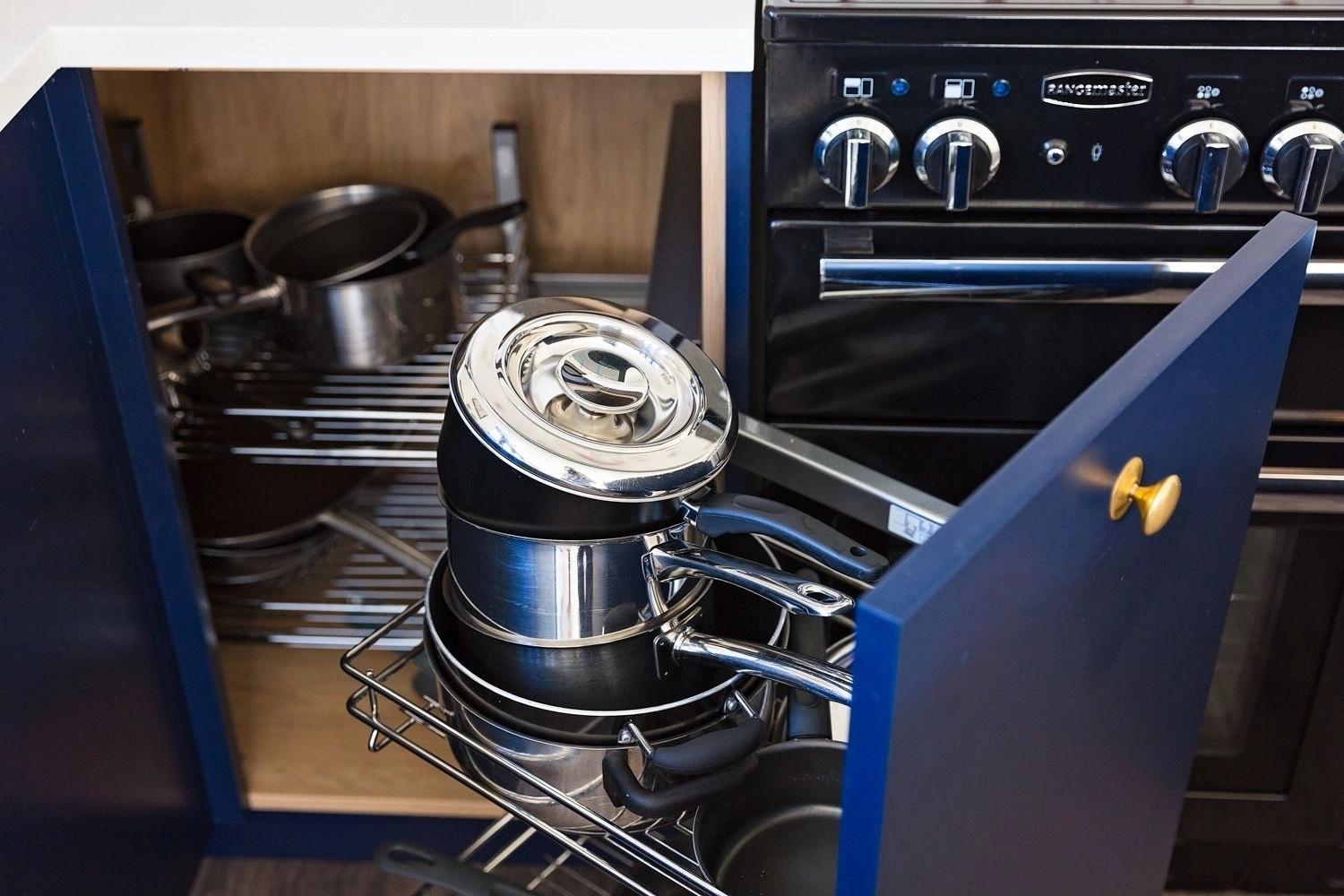
An articulated cabinet in the Beach House kitchen
Why guidelines are only the beginning
Those cubic metre figures and drawer ratios are helpful, but they describe an average household. In reality, no one actually lives an average life.
Do you batch cook every Sunday? Are you an enthusiastic baker with specialist equipment? Do you buy in bulk? Are you planning to host Christmas for 16? Are your children about to become teenagers with suddenly expanding appetites?
Storage planning is about how you cook and how often, how you shop and what you collect, as well as what might change over the next 10–20 years.
Storage that fits you
At Naked, we start with you and your life, and design your kitchen around that. What drives you mad in your current kitchen? What do you reach for every day? What’s always in the way? What do you wish you had space for?
We won’t try to fit you into a standard template or a fixed “ideal” layout. Instead, we build storage around you: your habits, your home, your future plans. That’s a truly bespoke kitchen.
Start your kitchen journey today.
Frequently Asked Questions
How can I calculate how much storage I need?
Start with the 1.5–2.5 cubic metres per person guideline. Then audit what you currently own and how you cook. The numbers provide a baseline — your lifestyle refines the plan.
How many drawers should a kitchen have?
Most family kitchens benefit from at least 6–10 drawer units, including several deep pan drawers. Drawers improve accessibility and reduce wasted space compared to traditional cupboards.
Can you include a larder in a small kitchen?
Yes. A well-designed, ceiling-height larder can often provide more efficient storage than multiple smaller cupboards, even in compact spaces.
See also:
Choosing colours for your kitchen – an expert guide
Small but beautiful: A complete guide to designing and maximising the space in a small kitchen
Request a Brochure
To receive a digital copy of our brochure and regular updates from us, please complete your details below.